BlinkLinMulT: Transformer-Based Eye Blink Detection
Ádám Fodor, Kristian Fenech, András Lőrincz
Abstract
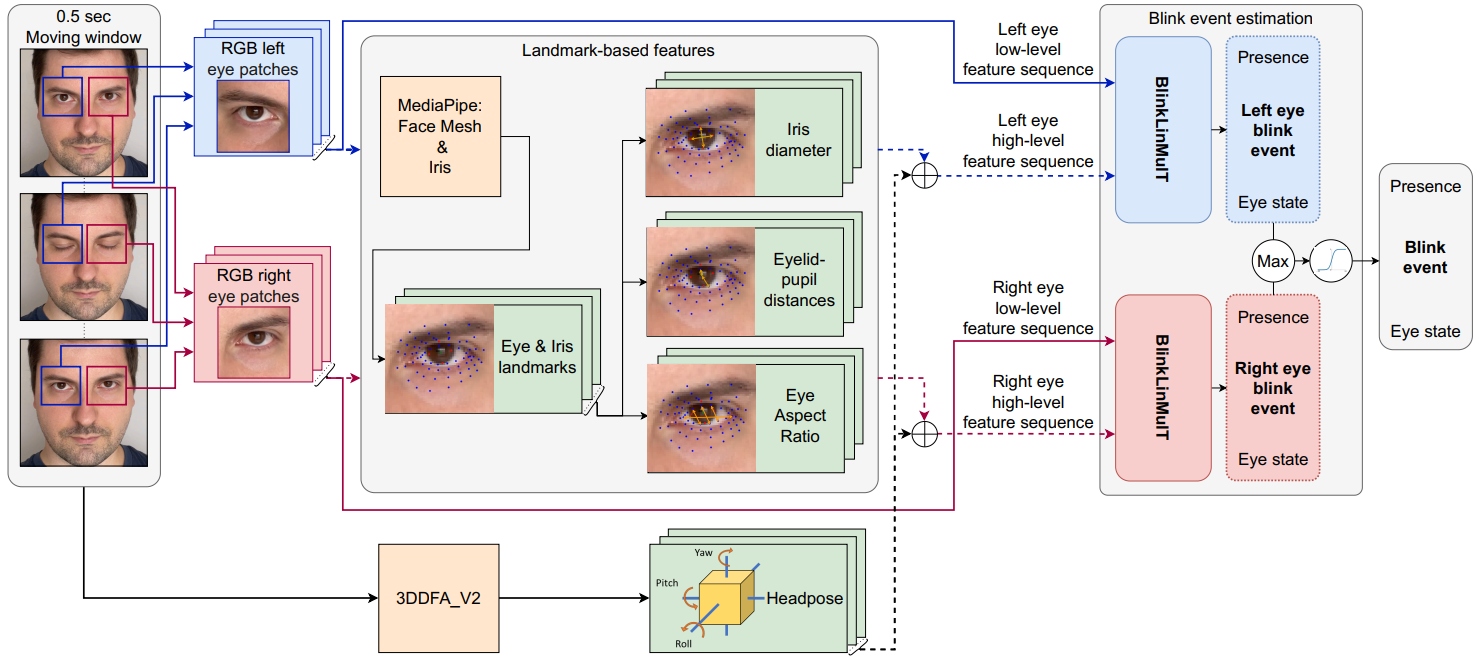
This work presents BlinkLinMulT, a transformer-based model for eye blink detection. While most existing approaches rely on frame-wise eye state classification, recent advancements in transformer-based sequence models have not been explored in the blink detection literature. Our approach effectively combines low- and high-level feature sequences with linear complexity cross-modal attention mechanisms and addresses challenges such as lighting changes and a wide range of head poses. Our work is the first to leverage the transformer architecture for blink presence detection and eye state recognition while successfully implementing an efficient fusion of input features. In our experiments, we utilized several publicly available benchmark datasets (CEW, ZJU, MRL Eye, RT-BENE, EyeBlink8, Researcher’s Night, and TalkingFace) to extensively show the state-of-the-art performance and generalization capability of our trained model. We hope the proposed method can serve as a new baseline for further research.
- Develop a fast and accurate transformer-based framework for eye blink detection and eye state recognition using video sequences.
- Combine low- and high-level multimodal features including RGB texture, iris and eye landmarks, eye aspect ratio, and head pose angles.
- Handle challenges like lighting changes, extreme head poses, and noisy input data.
- Detecting subtle and transient blink events that last only a few frames.
- Dealing with large variations in head pose, gaze angle, and occlusions.
- Ensuring robustness across multiple diverse datasets and real-world scenarios.
- Balancing model accuracy with computational efficiency for real-time applications.
- Fusing heterogeneous features (texture, landmarks, head pose angles) effectively.
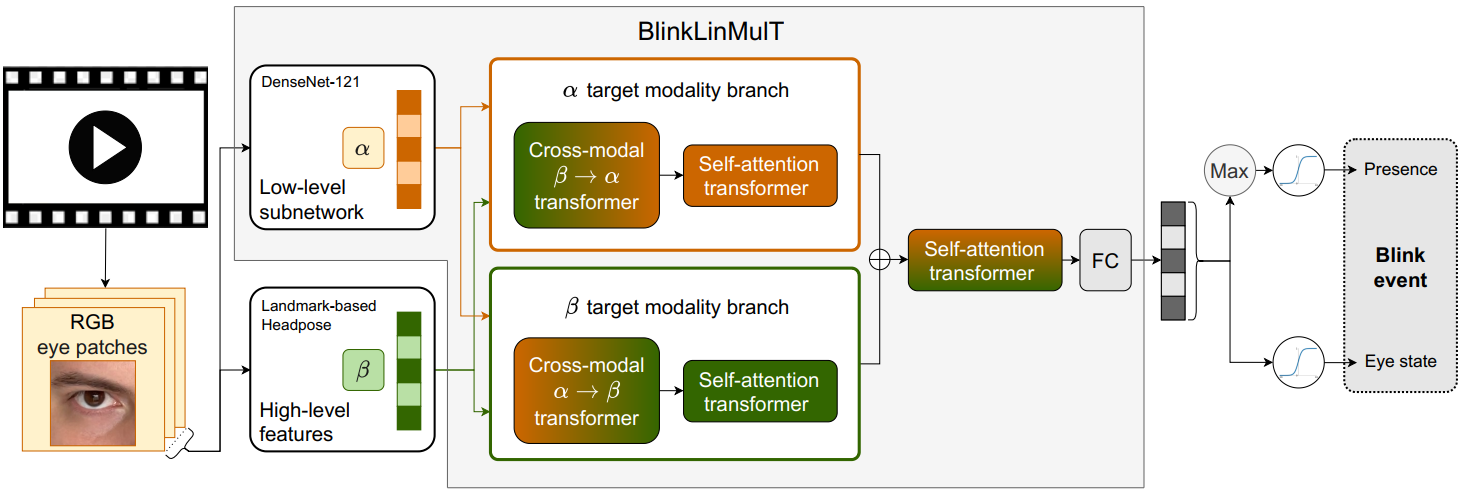
- Introduce BlinkLinMulT, a multimodal transformer architecture with linear attention mechanisms for efficient fusion of input feature sequences.
- Input features include RGB eye patches extracted via CNN backbones, iris and eye landmarks, eye aspect ratio computations, and head pose angles estimated by specialized neural nets.
- Cross-modal transformers translate features between modalities, followed by self-attention layers for enhancing temporal information.
- Final head consists of a fully connected layer producing blink presence and eye state predictions at frame and sequence levels.
- Utilize linear complexity attention to reduce computation time and memory consumption compared to quadratic attention.
- BlinkLinMulT achieves state-of-the-art or highly competitive performance on multiple public benchmark datasets including CEW, ZJU, MRL Eye, RT-BENE, EyeBlink8, Researcher’s Night, and TalkingFace.
- Cross-dataset evaluations demonstrate robustness, with models trained on unioned datasets outperforming those trained on single datasets separately.
- Ablation studies highlight the importance of combining RGB texture with eye and iris landmarks and head pose for best performance.
- Accuracy slightly decreases for large yaw and pitch angles, but remains acceptable for extreme head poses.
- Sequence modeling with transformer layers outperforms frame-wise methods, especially in recognizing temporal blink patterns.
- Linear attention significantly reduces inference time and memory usage, enabling practical real-time eye blink detection.
From paper to production
The 2023 paper was the starting point, not the end. The repository now ships four models behind one interface, an optimized inference path, and a statistically grounded comparison of which model is actually better.
ONNX optimization
- Exported behind a numerical-parity gate: the graph must agree with the PyTorch model to 4.8e-07 before it ships.
- 4.9× faster inference — 20.19 → 4.15 ms/frame.
- The ONNX extra runs all four models without importing torch, saving 469 MB in a deployment; a packaging test fails if that regresses.
Real-time pipeline
- Face detection, eye localisation, head pose, and blink scoring at 42.8 fps on CPU.
- That number came from profiling the pipeline, not from guessing where the time went.
- Runs live from a webcam, offline over video files, or as a Docker REST service.
Statistical model comparison
- “Model A scored higher” is not the same claim as “model A is better”, so the comparison is a test rather than a table of point estimates.
- Recording-clustered paired bootstrap over 35 held-out recordings, resampling recordings rather than frames.
- 95% confidence intervals and Holm-corrected p-values across all six pairwise comparisons.
Engineering
- 96% line coverage, enforced in CI by Codecov, behind a
make checkgate — ruff, ty, the suite, and a docs build — that runs in about 40 seconds. - One
BlinkDetectorclass serves all four models, ONNX and PyTorch alike, with weights resolved from the Hugging Face Hub on first use. - Trained with PyTorch Lightning across multiple GPUs (DDP, data-parallel), and published Sphinx API documentation, ruff linting, and coverage reporting.
Which model is actually better?
Average precision on the RN30 test split — 35 held-out recordings, 54 814 valid frames, 1.04% positive. Intervals are 95%, from a paired bootstrap that resamples recordings.
| Model | Average precision | 95% CI |
|---|---|---|
| blinkcnn | 0.7893 | [0.700, 0.861] |
| blinklint-union | 0.4338 | [0.340, 0.540] |
| blinklinmult-union | 0.3815 | [0.204, 0.585] |
| densenet121-union | 0.3569 | [0.213, 0.617] |
Visualization
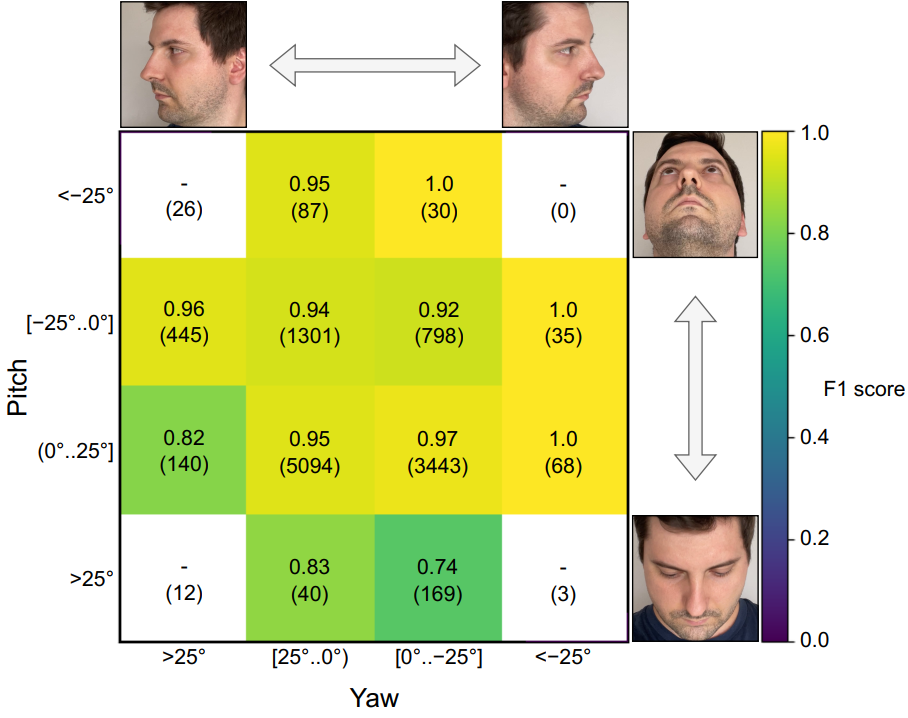
Head pose angle dependence of BlinkLinMulT in the case of blink presence detection task. The head poses are predicted by 3DDFA_V2; the colors represent the F1 score calculated for the blink presence task, which is also written within the boxes together with the number of samples (in parenthesis) considered during the metric evaluations. F1 score cannot be calculated for those extreme cases, where closed-eye samples are not available.
Test samples from all 5 sequence datasets are used for the experiment. Blinks can be predicted accurately in the case of frontal faces, and while the participant is looking up. Performance slightly decreases when the monitored person is looking down.
BibTex
If you found our research helpful or influential please consider citing:
@Article{fodor2023blinklinmult,
   AUTHOR = {Fodor, Ádám and Fenech, Kristian and Lőrincz, András},
   TITLE = {BlinkLinMulT: Transformer-Based Eye Blink Detection},
   JOURNAL = {Journal of Imaging},
   VOLUME = {9},
   YEAR = {2023},
   NUMBER = {10},
   ARTICLE-NUMBER = {196},
   URL = {https://www.mdpi.com/2313-433X/9/10/196},
   PubMedID = {37888303},
   ISSN = {2313-433X},
   DOI = {10.3390/jimaging9100196}
}