Common Fate Based Episodic Segmentation by Combining Supervoxels with Deep Neural Networks
László Kopácsi, Áron Fóthi, Ádám Fodor, Ellák Somfai, András Lőrincz
Abstract
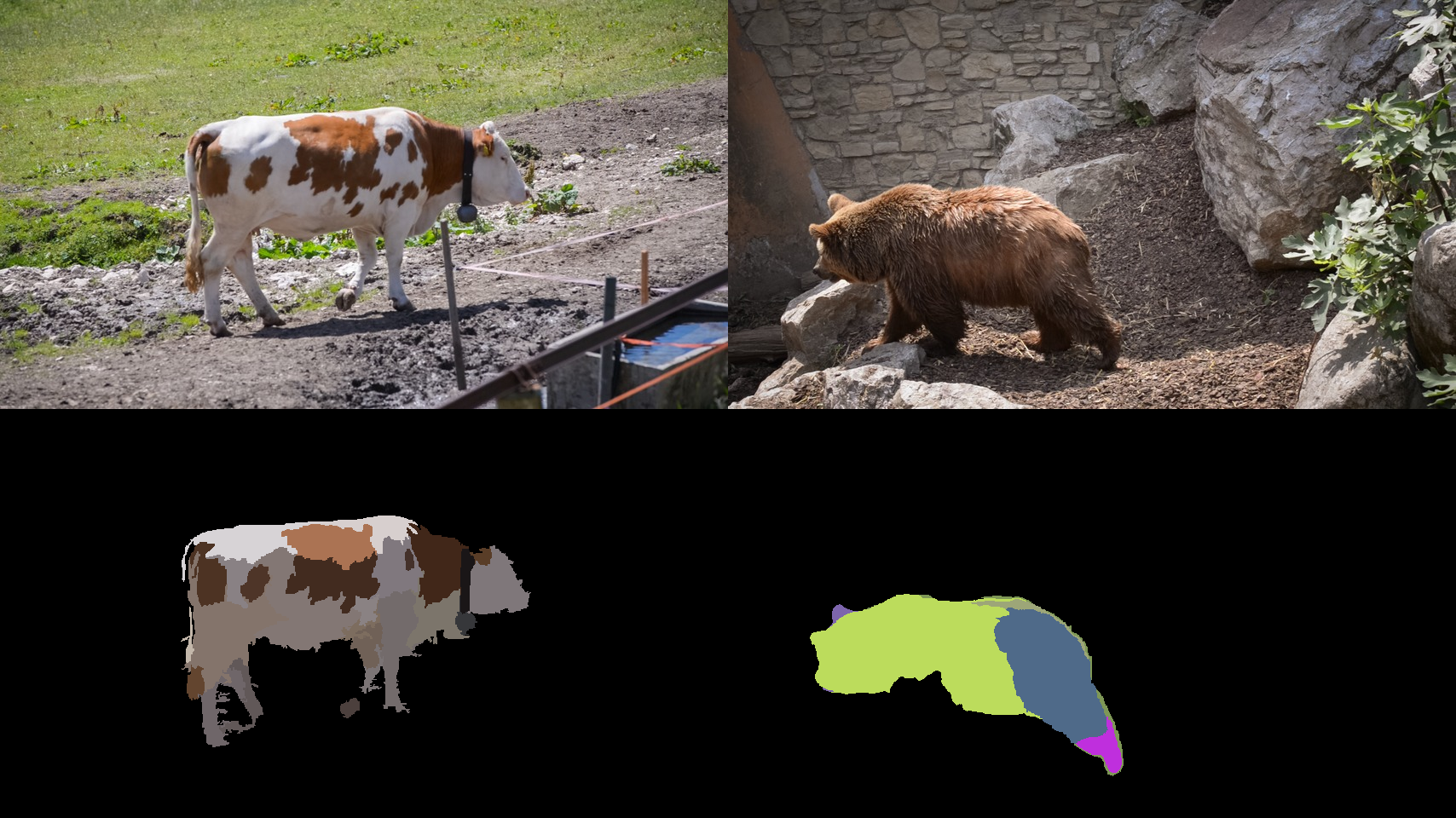
We estimated the contribution of different factors in segmentation tasks by means of deep neural networks. Results indicated that texture and optical flow have similar power, but they seem not to add up. In turn, we decided to study the ‘Common Fate Principle’ of the 100 years gestaltism suggesting that elements that move together belong together. We developed a simple, fast, and efficient episodic segmentation method that – to some extent – resembles the ‘how system’ of the visual processing: we dropped every piece of information except motion, and started from pure optical flow estimations on 2D videos. For the sake of segmentation, we used a parallel and fast hierarchical supervoxel algorithm. We studied (i) grid topology in space and time, (ii) 2D grid in space and topology dictated by the optical flow in time, and (iii) added deep network based depth estimation from 2D images. We measure performances on episodic foreground-background segmentation task of the Davis benchmark videos. Results are competitive to state-of-the-art segmentation techniques.
- Episodic segmentation of video based on motion (foreground-background segmentation).
- Combining motion and texture for segmentation is difficult and can reduce performance.
- Optical flow alone struggles to separate static or slow-moving object parts from the background.
- Noise in optical flow estimation and occlusion events degrade segmentation quality.
- Need for efficient, fast, and adaptive methods for spatio-temporal segmentation.
- Utilize only optical flow (motion) information for segmentation, inspired by the Gestalt "Common Fate Principle" (elements moving together belong together).
- Apply Borůvka’s minimum spanning tree algorithm for hierarchical supervoxel segmentation across space and time.
- Explore graph topology variations: regular spatial-temporal grids versus optical flow-based temporal connectivity.
- Optionally incorporate monocular depth estimation from deep neural networks to improve segmentation.
- Optical flow alone provides competitive segmentation results on the DAVIS benchmark.
- Combining optical flow with texture or RGB features can worsen segmentation performance.
- Depth information improves segmentation quality moderately.
- The method is simple, fast, and interpretable, highlighting the power of motion-based segmentation and suggesting the need for careful multi-feature fusion in future work.
Visualization
High quality examples for Common Fate Principle based segmentation.
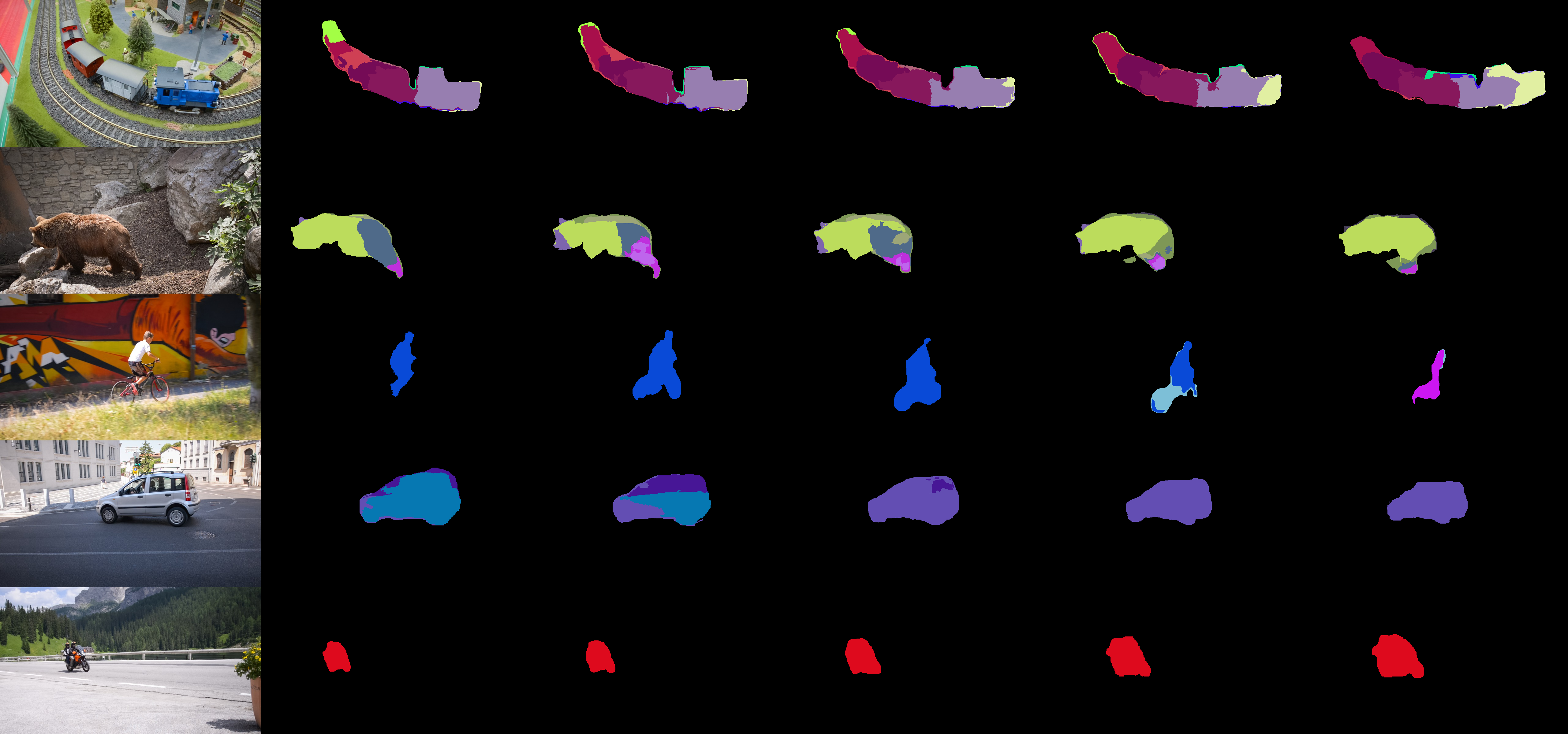
Middle row: case where occlusion spoils the result.
Columns in order from left to right: RGB image, supervoxel masks on the 1st, 4th, 8th, 12th and 16th frames.
BibTex
If you found our research helpful or influential please consider citing:
@INPROCEEDINGS{8851697,
   author = {Kopácsi, László and Fóthi, Áron and Fodor, Ádám and Somfai, Ellák and Lőrincz, András},
   booktitle = {2019 International Joint Conference on Neural Networks (IJCNN)},
   title = {Common Fate Based Episodic Segmentation by Combining Supervoxels with Deep Neural Networks},
   year = {2019},
   pages = {1-7},
   doi = {10.1109/IJCNN.2019.8851697}
}