Perceived Personality State Estimation in Dyadic and Small Group Interaction with Deep Learning Methods
Kristian Fenech, Ádám Fodor, Sean P. Bergeron,
Rachid R. Saboundji, Catharine Oertel, András Lőrincz
Abstract
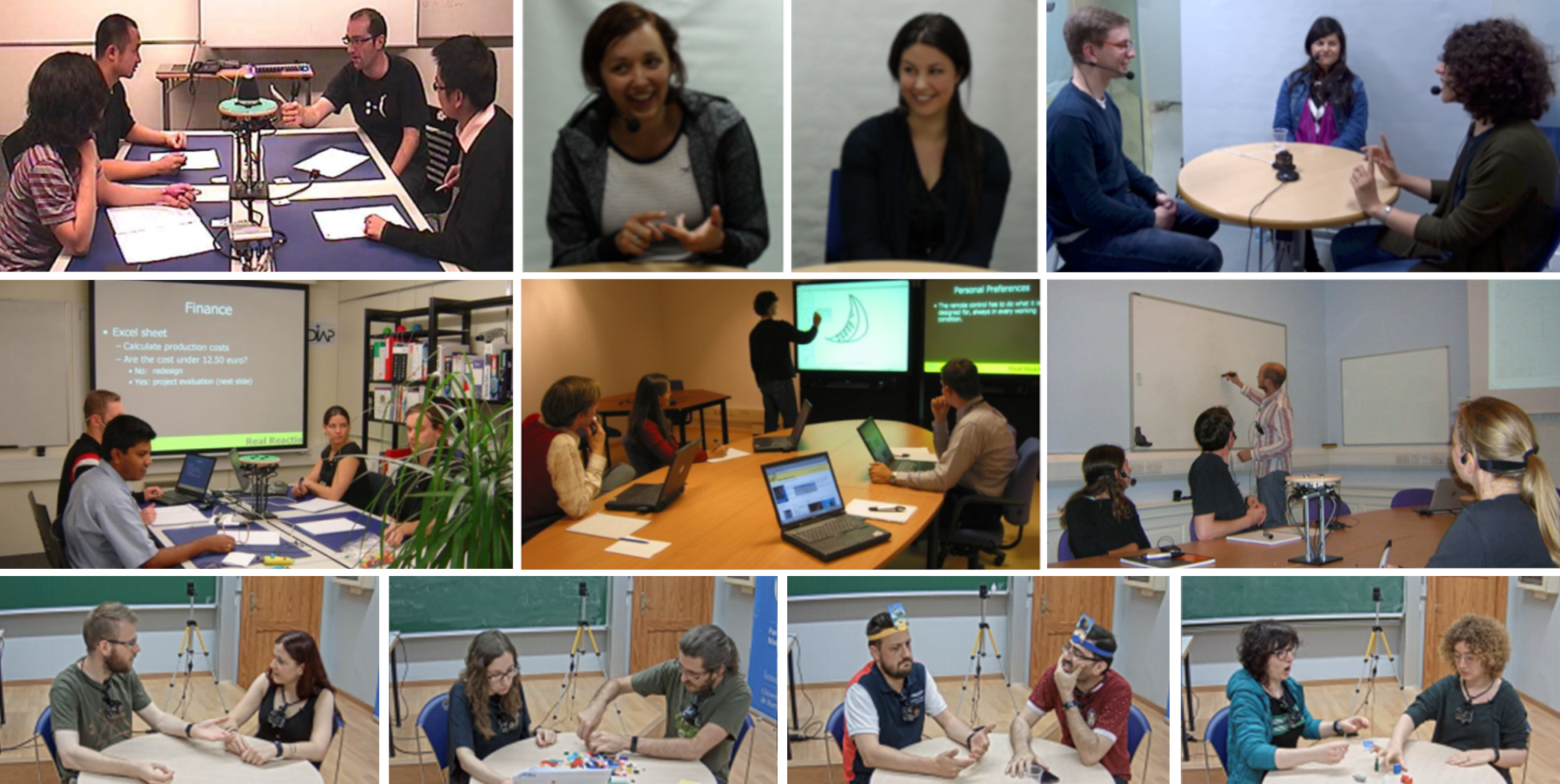
Dyadic and small group collaboration is an evolutionary advantageous behaviour and the need for such collaboration is a regular occurrence in day to day life. In this paper we estimate the perceived personality traits of individuals in dyadic and small groups over thin-slices of interaction on four multimodal datasets. We find that our transformer based predictive model performs similarly to human annotators tasked with predicting the perceived big-five personality traits of participants. Using this model we analyse the estimated perceived personality traits of individuals performing tasks in small groups and dyads. Permutation analysis shows that in the case of small groups undergoing collaborative tasks, the perceived personality of group members clusters, this is also observed for dyads in a collaborative problem solving task, but not in dyads under non-collaborative task settings. Additionally, we find that the group level average perceived personality traits provide a better predictor of group performance than the group level average self-reported personality traits.
- Analyze perceived personality traits of individuals during dyadic and small group interactions.
- Investigate the emergence of group affect in collaborative social settings using multimodal data.
- Examine whether perceived personality traits cluster within groups and assess relations with group performance.
- Predict group performance based on aggregated perceived and self-reported personality traits.
- Modeling dynamic personality expression influenced by social context and task demands.
- Handling variability in data including occlusions, diverse head poses, and incomplete multimodal observations.
- Ensuring reliability and generalizability of perceived personality estimations compared to human raters.
- Addressing limitations of current datasets which may not fully capture variations in personality states during interactions.
- Analyzing groups with differing communication styles, including collaborative versus competitive tasks.
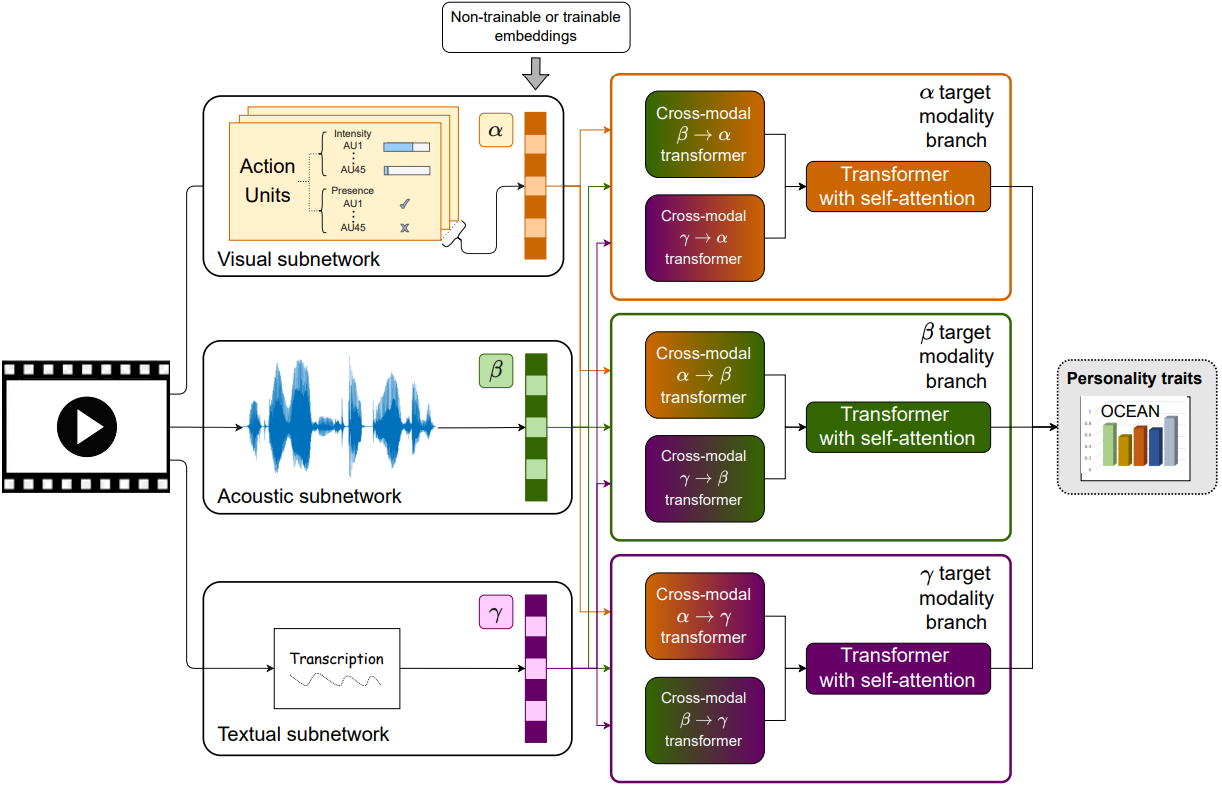
- Use a Multimodal Transformer with Linear Complexity Attention (LinMulT) to estimate perceived personality traits from audiovisual and transcript data.
- Apply LinMulT to generate time-series predictions of personality traits over sliding analysis windows.
- Exclude non-speaking segments to improve estimation accuracy.
- Calculate higher-level personality metatraits such as Plasticity and Stability from estimated Big Five traits.
- Evaluate group-level convergence using cluster analysis and Permutational MANOVA tests on perceived personality data.
- Predict group performance with Gradient Boosted Trees using aggregated perceived and self-reported personality features.
- The LinMulT model's performance in estimating perceived personality traits is comparable to human annotators, with good reliability across traits.
- Statistically significant personality convergence (group affect) is observed in collaborative tasks across multiple datasets, but not in competitive or passive interaction tasks.
- Perceived personality traits form tighter clusters within groups than self-reported traits, indicating dynamic adaptation during social interaction.
- Aggregated perceived personality metatraits predict group performance more accurately than self-reported personality, highlighting the importance of external perception in group effectiveness.
- Results support the view that personality expression is dynamic and influenced by task context and interactions, with implications for understanding group dynamics.
- Limitations include dataset constraints and variability in observation conditions, calling for further research with richer data and enhanced methodologies.
Visualization
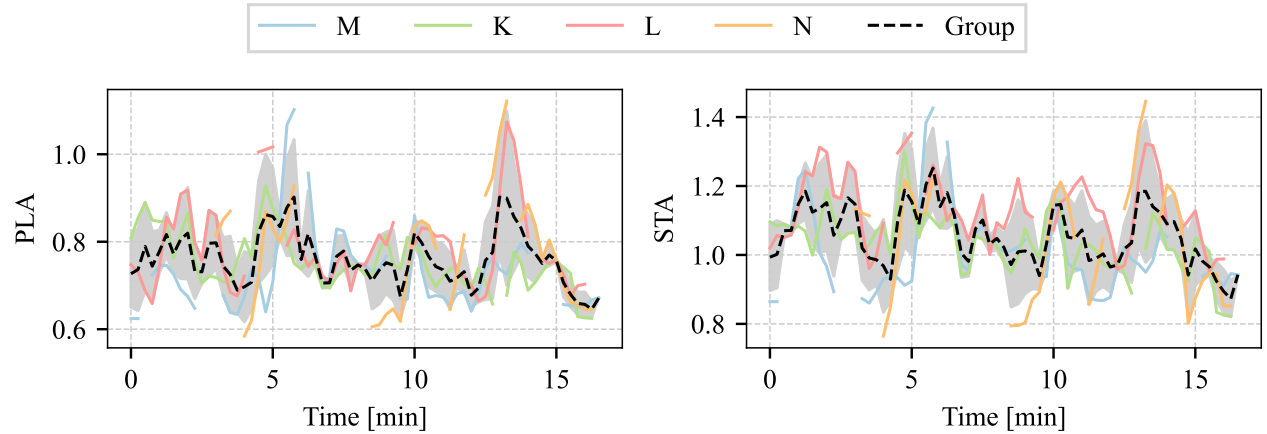
Illustrative sample of the temporal changes in the perceived personality meta-traits of plasticity (left) and
stability (right).
Coloured curves: Trait estimation for individual participants, where each participant is assigned a
letter in place of a name for anonymisation in the dataset.
Missing line segments: non-speaking intervals.
Dashed
line: average over participants.
The grey shaded area gives the standard deviation of the individual values.
Perceived
personality tend to move together over time.
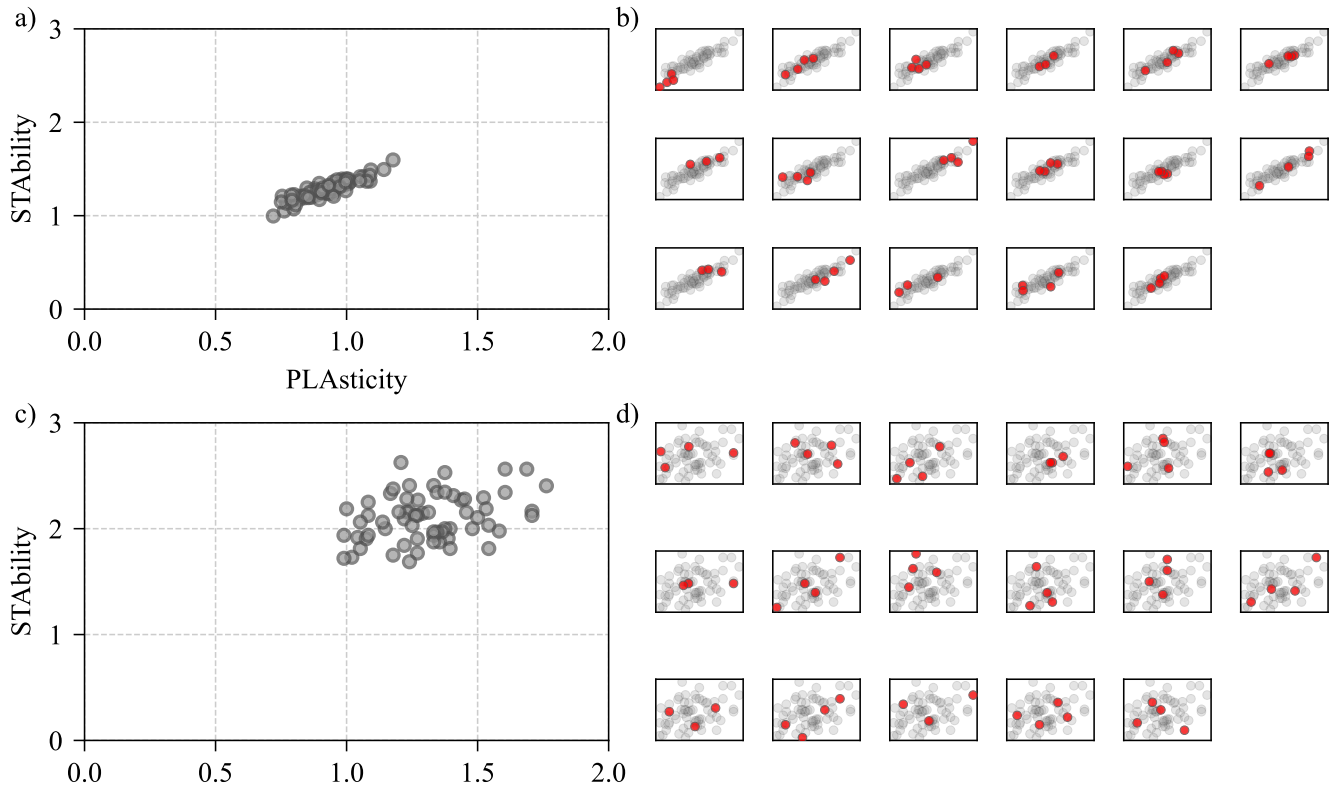
On the following figure stability and plasticity values are visualized.
a) First-impression personality state averaged over the full session duration.
b) Each subplot shows the original averages as seen in a). Traits corresponding to the members of other group are
highlighted by the red circles.
c) Plasticity and stability determined from self reported big-five traits, re-scaled between
0 and 1.
d) Each subplot shows the original averages as seen in c). Traits corresponding to the members of other group
are highlighted by the red circles.
The observed group effect is strong in the first-impression personality state.
BibTex
If you found our research helpful or influential please consider citing:
@misc{fenech2022perceived,
   title = {Perceived personality state estimation in dyadic and small group interaction with deep learning methods},
   author = {Kristian Fenech and Ádám Fodor and Sean P. Bergeron and Rachid R. Saboundji and Catharine Oertel and András Lőrincz},
   year = {2022},
   eprint = {2211.04979},
   archivePrefix = {arXiv},
   primaryClass = {cs.HC},
   doi = {10.48550/arXiv.2211.04979}
}