Speech de-identification with deep neural networks
Ádám Fodor, László Kopácsi, Zoltán Á. Milacski, András Lőrincz
Abstract
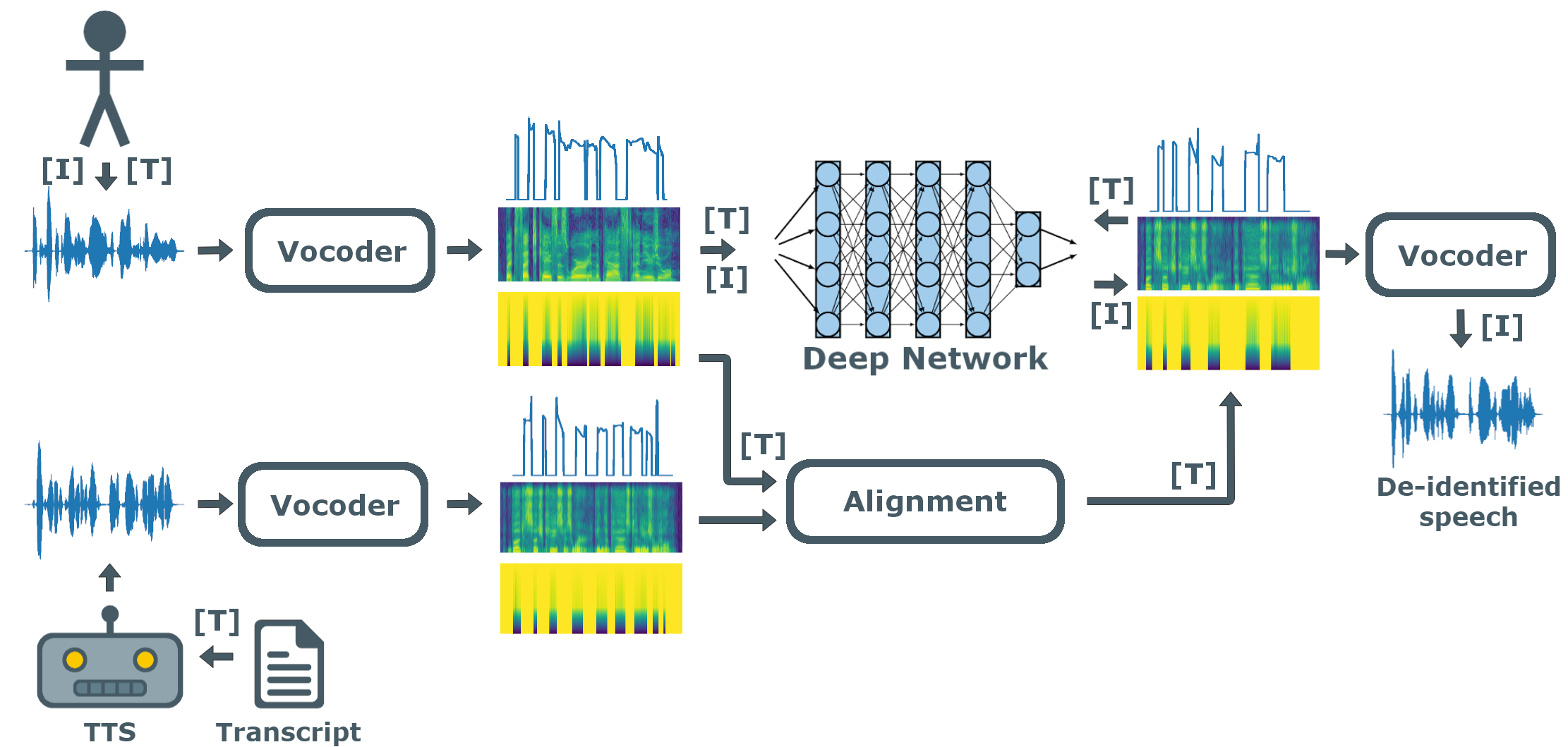
Cloud-based speech services are powerful practical tools but the privacy of the speakers raises important legal concerns when exposed to the Internet. We propose a deep neural network solution that removes personal characteristics from human speech by converting it to the voice of a Text-to-Speech (TTS) system before sending the utterance to the cloud. The network learns to transcode sequences of vocoder parameters, delta and delta-delta features of human speech to those of the TTS engine. We evaluated several TTS systems, vocoders and audio alignment techniques. We measured the per- formance of our method by (i) comparing the result of speech recognition on the de-identified utterances with the original texts, (ii) computing the Mel-Cepstral Distortion of the aligned TTS and the transcoded sequences, and (iii) questioning human participants in A-not-B, 2AFC and 6AFC (Alternative Forced-Choice) tasks. Our approach achieves the level required by diverse applications.
- Speech de-identification by transforming human speech into a generic Text-to-Speech (TTS) voice to protect speaker privacy.
- Removing personal speaker characteristics without losing linguistic content.
- Ensuring irreversibility of transformation to guarantee privacy.
- Preserving speech intelligibility and quality after transformation.
- Limited availability of parallel speaker data for training traditional voice conversion systems.
- Train a deep neural network (DNN) to map vocoder parameters of human speech to those of a generic TTS engine voice using speech-text sample pairs.
- Learn the many-to-one voice transformation at the vocoder feature level, including Mel-Cepstral Coefficients (MCEP), fundamental frequency (F0), and aperiodicity features.
- Use Dynamic Time Warping (DTW) to align TTS outputs with original utterances for supervised learning.
- Test several DNN architectures including Dense, ConvNet, C-BLSTM, ResNet, and Wav2Letter models.
- Evaluate de-identification success via ASR accuracy drop, Mel-Cepstral Distortion (MCD), and human perceptual listening tests (A-not-B, 2AFC, 6AFC tasks).
- The method achieves strong de-identification with only minor degradation in automatic speech recognition accuracy (approx. 80-85% vs. 93% for aligned TTS baseline).
- Mel-Cepstral Distortion values indicate comparable or better performance than baseline voice conversion methods, confirming quality retention.
- Human listening tests show subjects are unable to reliably distinguish or identify speakers, confirming effective privacy protection.
- The approach requires only speech-transcript pairs for training, making it practical for large-scale applications.
- Limitations include inherited speech dynamics due to DTW alignment, suggesting future work to incorporate DTW in loss functions for improvement.
Visualization
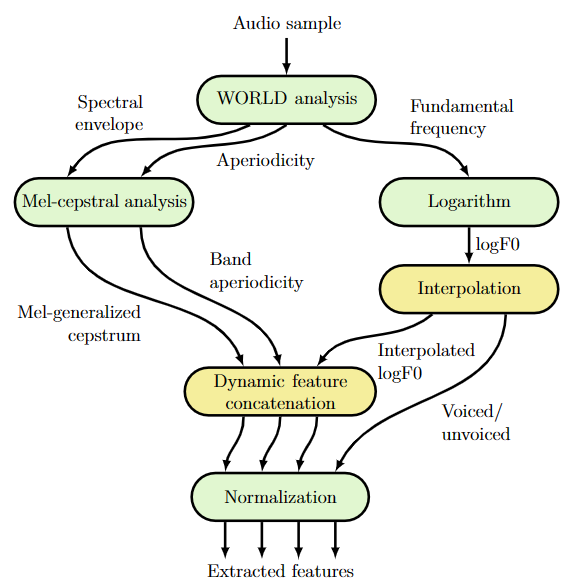
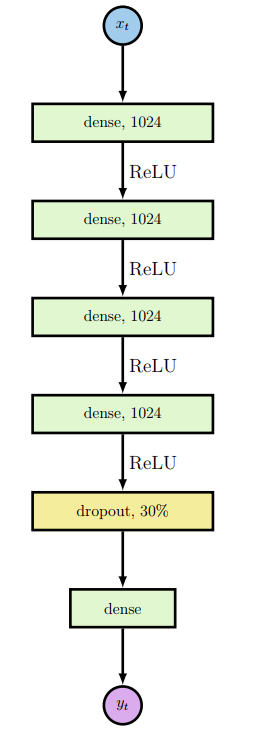
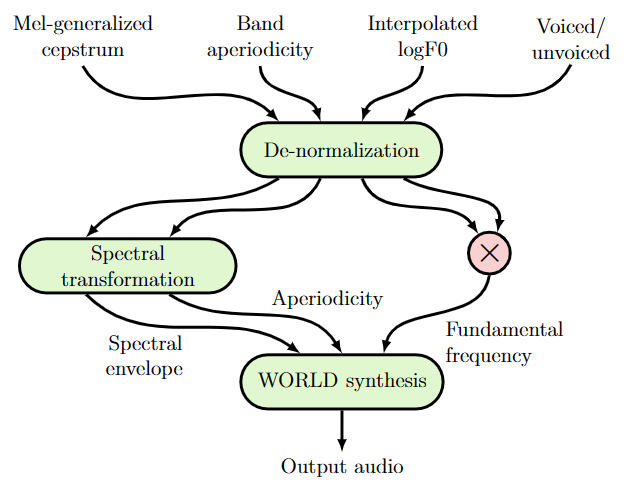
Explore the network's transformations: original inputs on the left, modified results on the right.
BibTex
If you found our research helpful or influential please consider citing:
@article{fodor2021deidentification,
   author = {Fodor, Ádám and Kopácsi, László and Milacski, Zoltán Ádám and Lőrincz, András},
   title = {Speech De-identification with Deep Neural Networks},
   journal = {Acta Cybernetica},
   volume = {25},
   number = {2},
   pages = {257-269},
   year = {2021},
   DOI = {10.14232/actacyb.288282},
   url = {https://cyber.bibl.u-szeged.hu/index.php/actcybern/article/view/4178}
}